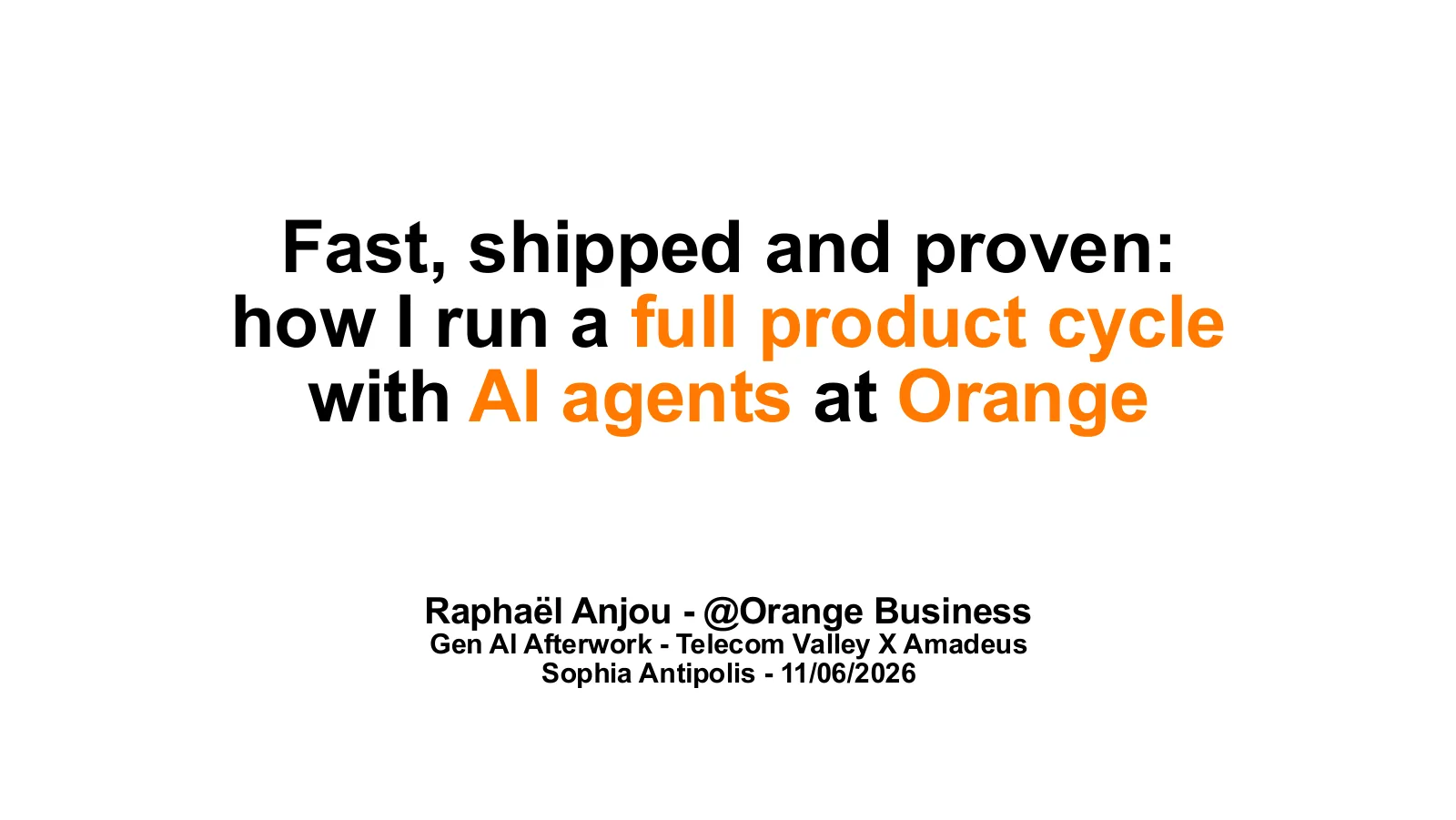
Fast, shipped and proven: how I run a full product cycle with AI agents at Orange
The harness I use to take features from discovery to production with AI agents, and why building the right thing beats building fast.
Gen AI Afterwork, Telecom Valley x Amadeus
A GenAI evening hosted by Amadeus with Telecom Valley, with talks from Google, AWS, Microsoft Azure, Cognition and Orange.
90 attendees20min + Q&A🇬🇧Conferences
Video replay
Amadeus and Telecom Valley invited me to their Gen AI Afterwork, to speak for Orange on the same evening as Google, AWS, Microsoft Azure and Cognition. I had twenty minutes to show how I actually work, so this is the talk slide by slide, with what I said about each one. Scroll, and the slides follow.
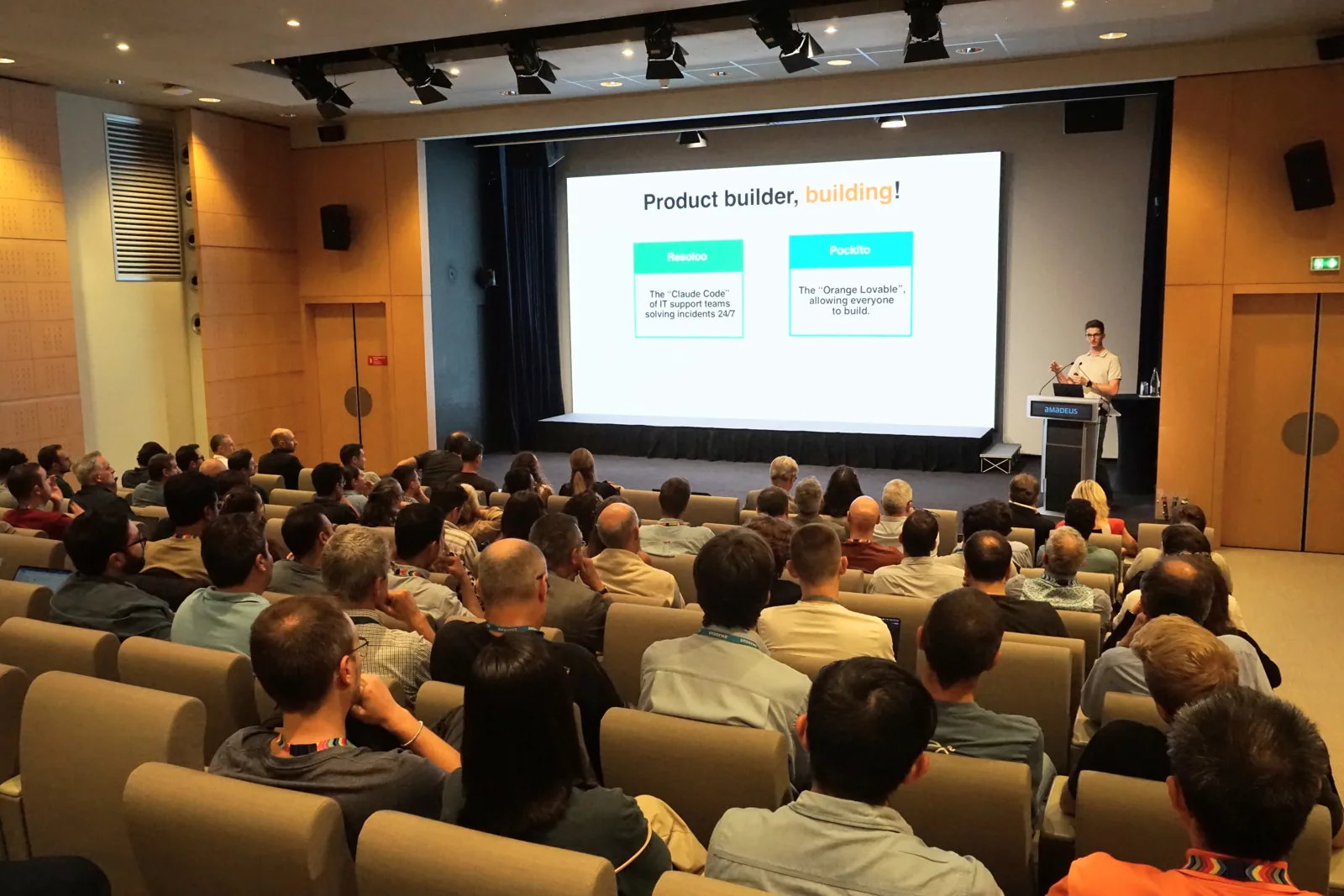
Around ninety people at Amadeus, Sophia Antipolis.
How I build differently, and where AI agents sit across the whole software development life cycle. Not just the part where code gets written.
Slide 2
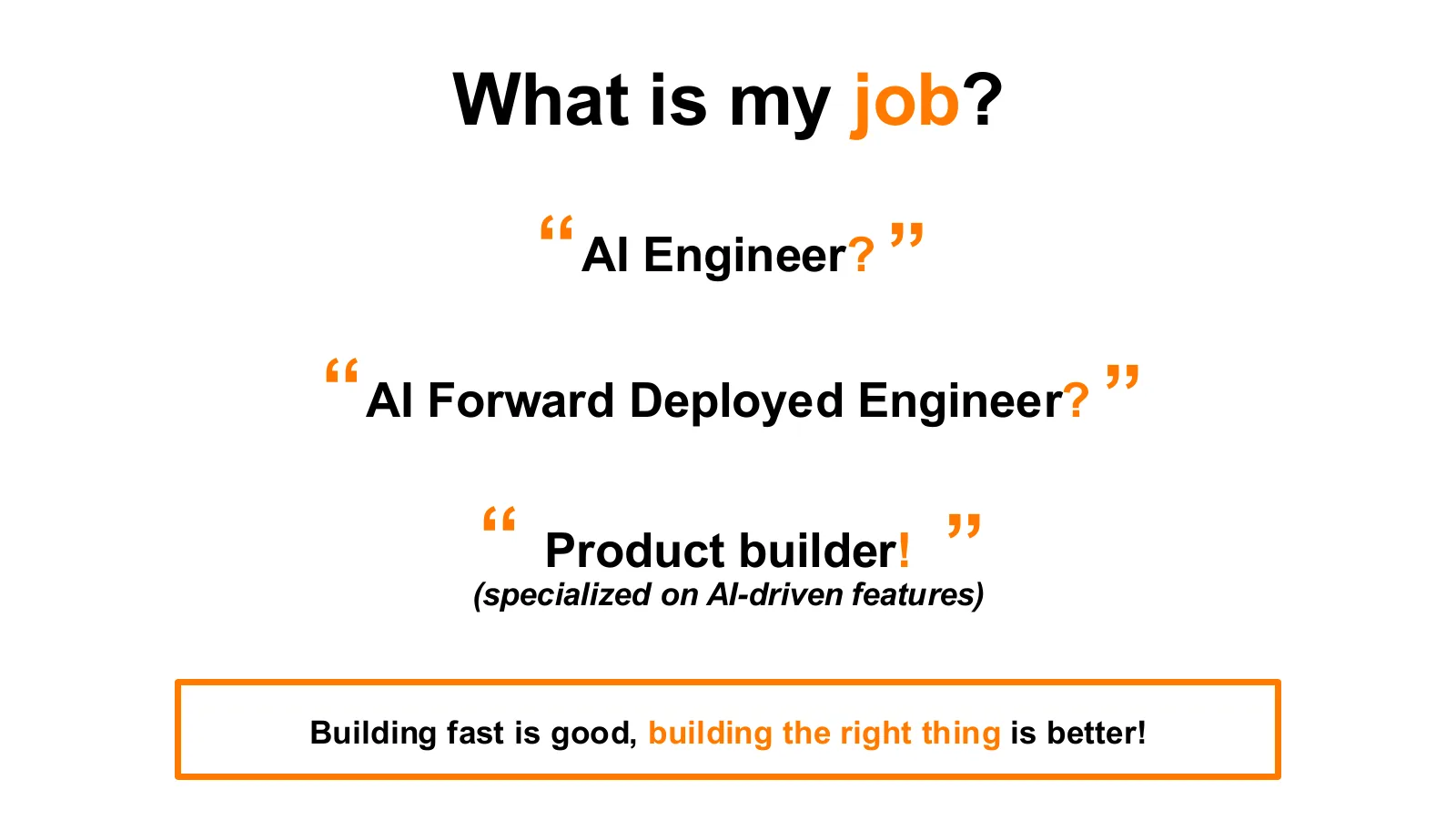
Defining my job is surprisingly hard these days. "AI engineer" puts all the weight on the AI. "AI forward deployed engineer" (embedded in a company's processes to change how it works) is closer. In the end I call myself a product builder: I do a lot of AI features because that is the engineer in me, but the point is solving a problem users actually have.
Building fast is good. Every tool on the market proves we can. Building the right thing is better, and that is what the rest of this talk is about.
Slide 3
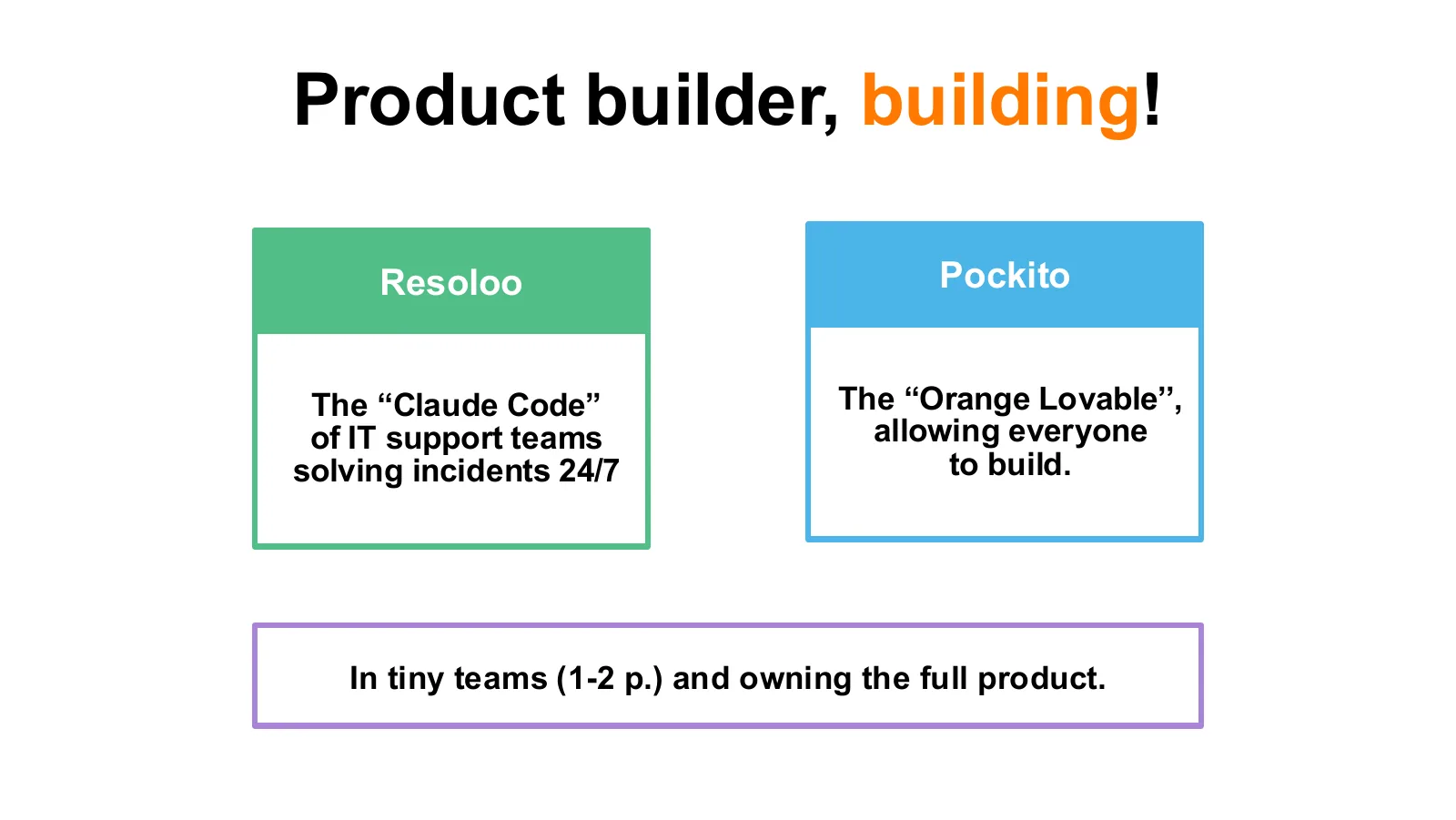
Two products. Resoloo is a Claude Code for IT operations, for the support teams who solve incidents 24/7. POCkito is an Orange Lovable: sales use it to mock up a solution before selling it, colleagues use it to build internal dashboards.
Each one is built by one or two people who own it end to end. They are a few months old, and they are not proofs of concept: they run in production with hundreds of daily users.
Slide 4
Small teams invite the obvious question: so we cut headcount? I think AI is an opportunity to do more with the same people, not the same with fewer.
My favourite example is IKEA. They automated 47% of their support. Instead of letting everyone go, they looked at the remaining 53% and saw people needed help with interior design. Support became remote interior design consulting, and that opened a billion-dollar business line.
Slide 5
My toolbox: Dinootoo, our internal ChatGPT. GitHub Copilot. Claude Code, plugged into both our self-hosted models and a cloud provider (and I optimise tokens wherever I can find some). POCkito for proofs of concept and mock-ups. And a custom harness around all of it, which is where the interesting part is.
Slide 6
Those tools are often used like a hammer on everything. The failure modes I see most:
Token maxing. Measuring developer productivity by tokens spent. People will just burn tokens on useless work.
Context rot. Not caring what you feed the agent, until everything gets messy.
Agent blame. "The agent broke production." No, the person behind the agent did.
Goal drift. You start one task and finish ten others nobody planned.
Slop flood. Agents generate content endlessly, but someone has to review it. Flood everyone and nobody can work anymore.
Slide 7
I borrowed this diagram from Martin Fowler's site because it is very good. The human steers. Feedforward is how you help the agent before it acts; feedback is how you tell it "you messed up, here is what to fix". Both come in two flavours: computational (plain old code doing great things, like we always had) and inferential (helping the agent gain information).
That is all a harness is: building things around your agent so it works better.
Slide 8
Mine, from left to right:
CLIs for every tool I use at work. If I work in Jira, GitLab and Sonar, my agent needs them too to do a good job.
Skills and commands, stored in Packmind, a registry where skills live at company, business unit, team or user level. That is how best practices spread, and how a huge pile of skills stays maintained.
A second brain in Obsidian. It predates the AI era, and it turns out agents love it: I never re-explain who the sponsors are, the business context, or what was decided.
Sub-agents for specialised roles: architect, security, a "chief product officer".
Guardrails, including the classic CI tools. We had amazing tools before AI. Combine the old school with the new.
Slide 9
Switching to the product lifecycle, which I work across end to end. Here is the complex version of the diagram…
Slide 10
…and here is how I like to simplify it. Build the right thing, then build the thing right. That's about it.
When companies say they will "put AI in the SDLC", they usually mean the developer part, which is half of the cycle at most. All the other opportunities get lost.
Slide 11
Re-complexified a little: you discover what to build, build it, ship it to production, measure whether it is used and working, learn from that, and loop.
Slide 12
The earlier you fail, the cheaper it is to fail. And we fail a lot in software: features that don't work, that nobody uses.
Vibe coding has many issues for production code. To test a hypothesis, though, write code however you want: build the mock-up, show the user journey, ask "will that work for you?". Better, hand POCkito to a few users, let them build the tool they want, and look for what they have in common.
I also do proofs of concept as a daily practice, not an innovation sprint once a quarter. Stuck on a feature, I vibe-code a throwaway version on the side. In 30 minutes I learn whether my architecture survives, instead of finding out after a day of building.
And talk to users. I spend at least an hour a day with mine, coffee breaks included, which is why I am now just "the POCkito guy".
Slide 13
Not as cool a demo as Devin building everything, and more manual than you'd think, even though I can't remember the last line of code I wrote by hand (two years ago, probably).
/new-feature runs agents one after the other to challenge my idea: a chief product officer (does this fit the product?), a design lead, an architect, security. Basic software engineering, delegated so I get pushback. The output is a spec. /build takes that spec: scope, tests first, implementation, code review, then closing the session.
Closing matters. After an hour, the agent has seen a large part of the codebase, so I ask what we learned: tooling issues, tech debt, new ideas. A retrospective every session, dozens a day.
Slide 14
/release runs the end-to-end tests on UAT, updates the technical and product docs, and writes the release note. Then CI/CD does the rest. My agent does not SSH into production; we have pipelines, gates and rollbacks, no need to reinvent them.
Product docs matter more than I expected. Users told me "Raphaël, you're building too fast, we don't understand the product anymore", and I had to run retraining sessions. You can't shrink a user's learning curve, only support it.
Operations get their own commands: /qos, /diagnose ("a user has a 502, what's happening?"), /adoption, and /red-alert, because someone will message you that you're down and they demo in two hours.
Slide 15
Shipping is not the end; you need to know whether it is used and working. More data means more correlation means more insight. A slightly psychopathic level of watching what users do.
Correlating all of that used to need a data scientist or a product person. Now I ask an agent to spend an hour on it and come back with insights, then drop them into the second brain. Crossed with user feedback, that tells me what to build next.
Slide 16
Three rules for building your own:
Give the agent your tools. Which tools do you use for the task? A custom CLI or MCP server is about 30 minutes against an API. Just check you are allowed to send that data to the agent you use.
Treat repeated failures as harness bugs. Seen the same failure 15 times today? Step back and find out why. Usually it is one tweak, or one word the agent reads differently from you.
Never type the same prompt twice. Make it a skill, a command or a sub-agent, and combine them. Finding the right level takes practice.
Slide 17
Failing in discovery is cheaper than failing in delivery. That is the whole point of this talk. So give AI tools to the non-developers too, instead of telling developers "you're AI-powered now, eat the Q2 roadmap in Q1". If your developers talk to users, even better.
Coding is not the only place to optimise. Knowing what to build and reviewing what got built are the hard parts.
And a worker is only as good as their tools. A few hours on a new CLI is not delivery, but it compounds.
Slide 18
A question to think about on the way home. If token prices went up a hundred times, where is the last place you would stop using them?
I have heard development, architecture, analysing feedback from thousands of users. Whatever your answer is, that is probably the core of what you do, and where improving your harness pays the most.
Slide 19
Thank you for listening. The questions start right after, and they were good ones.
Can a colleague reuse your whole harness tomorrow? Partly. Skills and commands are in Packmind and starting to be shared, and those matter most: if an expert writes the skill for Java concurrency, I don't want to rewrite it. My CLIs are not shared. Each took ten minutes to build, and I am honestly unsure whether to hand them out or let people build their own and keep the mindset.
Do the models run locally? Not on my laptop. At Orange, some workloads can go to a private Azure tenant with the latest models, and we also run our own models on our own GPUs inside the internal network, up to around 150 billion parameters.
How do you save tokens? Attach models to skills: Opus for the architect, a smaller model for /build. And RTK (Rust Token Killer), a hook that strips useless tool output before the agent sees it, cutting tokens by around 80% on commands like git status. No AI in it, just code.
Is your second brain shared? No. I don't want to share my brain. The shared brain is documentation; mine is full of who I talked to about what, which nobody else would want.
Do you miss writing code? No. I prefer the product side. I think tomorrow's developers split in two: product-minded builders who make what users want, and deep experts for things like NIS2 compliance or scaling to a million users. How someone becomes that expert without the years in the middle, I have no clue. That is the bigger problem.